





















Stability of Composite Smooth Shells with Peripheral Reinforcement Under Combined Loads
In this study, the buckling stability of flat composite shells with a thickness of 5 cm and individual element dimensions of 40 × 200 cm, arranged in an interconnected mesh and subjected to combined loads (axial, lateral, and external pressure), was investigated. Using the First-Order Shear Deformation Theory (FSDT) and numerical implementation in Abaqus, two environmental reinforcement strategies—temperature-dependent and external pressure-dependent functions—were integrated as controllable variables into the model. Nonlinear static analysis revealed that, without environmental reinforcement, the shells experienced sudden collapse at displacements of 7–11 cm. In contrast, temperature-based environmental reinforcement increased the yield load by up to 68%, and after surpassing the linear buckling threshold, the structure exhibited ductile behavior with significantly enhanced energy absorption attributed to the release of residual stresses and more uniform stress distribution across laminates. In the external pressure-based reinforcement model, although the yield load decreased, overall displacement was reduced by 10% and the maximum von Mises stress dropped by 82%, indicating effective mitigation of bending-induced stresses and improved post-buckling stability. Despite their distinct mechanisms, both reinforcement methods induced a qualitative shift in structural behavior—from abrupt, localized failure to controlled, gradual deformation. This study is the first to introduce and validate “environmental reinforcement” in composite shell literature as an active, equipment-free design strategy that transforms ambient conditions from destabilizing factors into performance-enhancing tools. The findings lay a foundation for the development of intelligent roofs, aerospace structures, and resilient systems in civil, aerospace, and defense engineering under complex loading scenarios.
A Sociological Analysis of the Effect of Social Capacity-Building on the Social Participation of Female Heads of Household in Activities Related to the Country’s Economic Development (A Study Based on the Grounded Theory Approach)
The purpose of this study is to conduct a sociological analysis of the effect of social capacity-building on the social and economic participation of female heads of household covered by the Welfare Organization of Tehran Province. The study examines various dimensions of social capacity-building, identifies the obstacles and challenges ahead, and ultimately provides practical strategies for empowering this group and facilitating their role in economic development. Methodologically, the research adopted a qualitative approach and employed the grounded theory method. The statistical population consisted of economic and social experts familiar with issues concerning women. Participants were selected through purposive sampling based on the criterion of theoretical saturation, resulting in a final sample size of 14 individuals. The primary data collection instrument was the semi-structured interview, and the obtained data were analyzed through three stages of open, axial, and selective coding, culminating in the development of a paradigmatic model. The key findings derived from the interview analyses indicated that the two categories of “empowerment strategies” (33.10%) and “economic development” (34.15%) were the most frequent and thus the most significant concepts. This demonstrates that the path to achieving economic development becomes smoother through focusing on practical empowerment solutions (such as training, networking, and access to resources). In contrast, “macro-level challenges” (11.27%)—structural, cultural, and psychological—were identified as the main obstacles. The final model of the research shows that social capacity-building strengthens social and economic participation through mediating mechanisms of reducing barriers and enhancing capabilities, although the intensity of this relationship is influenced by intervening factors such as macro-policies and structural challenges. Based on the above findings, it can be concluded that empowering female heads of household and increasing their participation requires an integrated program that simultaneously focuses on the micro level (strengthening individual skills), the meso level (strengthening local institutions and networks), and the macro level (reforming laws and policies). Moreover, the low rate of “scientific-executive foundations” (1.06%) in the findings underscores the need for greater attention to action-oriented research and the practical application of produced knowledge for policymakers and planners.
Designing a Digital Mentoring Model to Enhance Organizational Resilience in Energy Service Companies: A Pathway Toward Smart Process Transformation
This study aims to design and validate a digital mentoring model that enhances organizational resilience in energy service companies. A mixed-methods exploratory design was employed, integrating qualitative interviews and quantitative modeling. In the qualitative phase, semi-structured interviews were conducted with 15 experts in human resources, information technology, and organizational development, and the data were analyzed using thematic analysis in MAXQDA 2022. The quantitative phase utilized a researcher-developed questionnaire based on qualitative findings and was distributed to 130 randomly selected employees of the National Gas Company of Kerman Province. Measurement and structural models were assessed using PLS-SEM in SmartPLS 4, with reliability, convergent validity, and model-fit indices evaluated according to accepted thresholds. Inferential results showed that digital mentoring exerted a strong and significant direct effect on smart learning (β = 0.67, t = 12.84, p < 0.001). Smart learning significantly predicted organizational resilience (β = 0.59, t = 10.47, p < 0.001). An indirect mediation effect indicated that digital mentoring influenced organizational resilience through smart learning (β = 0.39, t = 3.98, p < 0.01). Digital transformational leadership demonstrated a significant moderating effect, strengthening the relationship between digital mentoring and resilience (β = 0.21, t = 2.06, p < 0.05). Model-fit indices supported the robustness of the structural model, including SRMR = 0.046, NFI = 0.91, and R² values of 0.45 for smart learning and 0.54 for resilience. Digital mentoring functions as a strategic learning and development mechanism that enhances resilience by improving adaptive learning capability, strengthening digital readiness, and enabling more effective leadership support. The validated model demonstrates that integrating digital mentoring into organizational development strategies can significantly reinforce resilience in technology-driven service environments.
Factors Affecting Economic Resilience for Transition from an Oil-Based Economy
Given Iran’s dependence on an oil-based economy—which has been a major factor in the emergence of structural problems and challenges within the national economy—evaluating the economic vulnerabilities resulting from sanctions on Iranian oil exports from various perspectives is crucial for achieving a resilient economy. The main objective of the present study is to compare the resilience of a knowledge-based economy with that of an oil-dependent economy and to assess the resilience of the entrepreneurial sector within Iran’s economy. Numerous indicators have been proposed for measuring resilience; among them, two variables—employment rate and economic growth rate (specifically, the growth rate of value added in knowledge-based [high-tech and medium-tech] sectors and in the oil sector)—will be utilized. To select the variables, key studies in the field of resilience have been reviewed, based on which the independent variables of this study include economic shocks such as sanctions, oil sector shocks, foreign trade shocks, patents and innovations, innovation index, exports and imports of knowledge-based products, and imports of capital goods, which represent the most important explanatory variables. For collecting information in the theoretical foundations section, the library method, note-taking, and consultation of Latin sources, books, and articles relevant to the topic will be employed. Data will be obtained from the websites of the Central Bank of Iran, the World Bank, and the World Economic Forum. After extracting the research data, the variables will be calculated and processed using Excel spreadsheet software. Subsequently, to perform statistical analysis and derive reliable results for evaluating the shocks, the Structural Vector Autoregression (SVAR) model will be applied, and the model estimation will be conducted using EViews software.
Designing a Participatory Governance Policy Framework in Iran's Telecommunications Industry
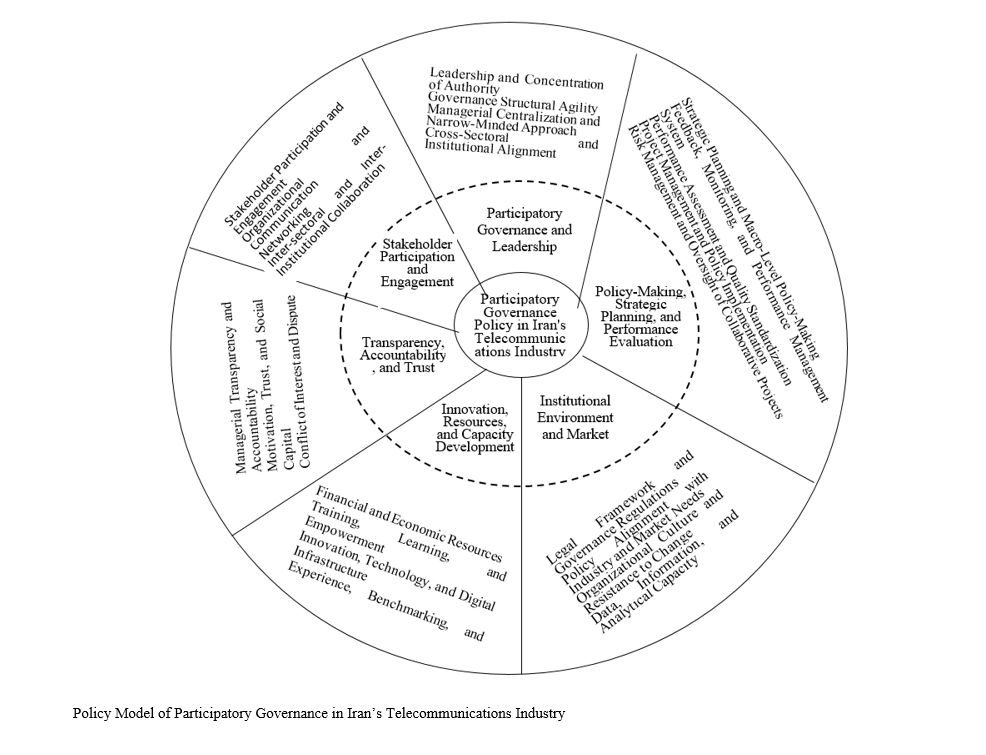
This study aimed to develop a policy framework for participatory governance in Iran's telecommunications industry. The research was qualitative in nature, employing a case-study approach within the Iranian telecom sector. Participants included managers and experts from telecommunications companies, related firms, as well as academics specializing in public administration and policy-making. Using purposive sampling with a snowball approach, 14 participants were selected until theoretical saturation was reached. Data were collected through semi-structured interviews and analyzed using thematic analysis (including initial coding, sub-themes, and main themes). The credibility and reliability of the data were confirmed through various validation techniques. Analysis of the interviews initially yielded 350 codes during open coding, which, after merging duplicates, were reduced to 213 primary codes. These were ultimately organized into 23 sub-themes and six main themes. The findings indicate that implementing participatory governance in Iran's telecommunications industry requires simultaneous reforms across six key areas: participatory leadership and governance, strategic policy-making and planning, active stakeholder engagement and collaboration, managerial transparency and accountability, development of innovation and technological capacity, and alignment with institutional and market environments. Therefore, establishing participatory mechanisms, enhancing interdepartmental coordination, expanding technological and human resource capacities, and aligning policies with market needs are essential for improving the effectiveness of participatory governance policies in this sector.
Designing a Policy Laboratory for the Center for Strategic Studies of the Presidency
The purpose of the present study is to design a policy laboratory and customize it for the Center for Strategic Studies of the Presidency. The research method is qualitative in nature and exploratory in purpose. Accordingly, thematic analysis was employed to develop the theoretical framework. In the qualitative phase of the study, two tools were used for data collection: note cards and semi-structured interviews. Through a review of the theoretical foundations and previous studies, initial note-taking was conducted, and by conducting purposive and snowball sampling interviews with experts, the dimensions, components, and final indicators for the policy laboratory design model were identified and determined. The findings of the study are categorized into four main themes: (1) antecedents of policy laboratory design, (2) stages of policy laboratory design, (3) the design of the policy laboratory itself, and (4) post-design outcomes of the policy laboratory. If policymakers and scholars utilize this model and establish a policy laboratory with an appropriate physical and environmental space, along with the recruitment of competent staff and engagement of stakeholders, it will be possible to design and formulate key solutions to address social problems. In general, the policy laboratory can become a venue for dialogue and interaction among experts who possess knowledge of various dimensions of major societal challenges.
VeriZKP: A Privacy-Preserving, Gas-less, and Granular Educational Credential Verification System on Ethereum using Zero-Knowledge Proofs
The digital transformation of education necessitates secure, private, and learner-centric methods for verifying academic credentials. Conventional verification processes expose sensitive personally identifiable information, creating privacy risks that conflict with data protection regulations like GDPR. Existing blockchain solutions for educational credential verification face persistent challenges including prohibitive transaction costs, privacy vulnerabilities, and inflexible verification models. This paper presents VeriZKP, a proof-of-concept architecture demonstrating gas-free credential verification on Ethereum using zero-knowledge proofs. The core innovation lies in separating on-chain trust anchoring from off-chain cryptographic computation, enabling a novel cost-elimination mechanism. The system leverages Ethereum’s view functions through pre-compiled verifier contracts to achieve zero gas consumption for verification operations while preserving privacy through selective disclosure mechanisms. Our prototype, evaluated on Ethereum Sepolia testnet, validates the fundamental feasibility of this approach. Results demonstrate complete elimination of verification costs, practical client-side proof generation times of 1.02-1.63 seconds on standard hardware, and support for multi-attribute credential verification. The architecture proves both economically viable and performant for blockchain-based identity systems.
A Mutual-Information-Guided and ADASYN-Augmented Machine Learning Framework for Early Prediction of Parkinson’s Disease
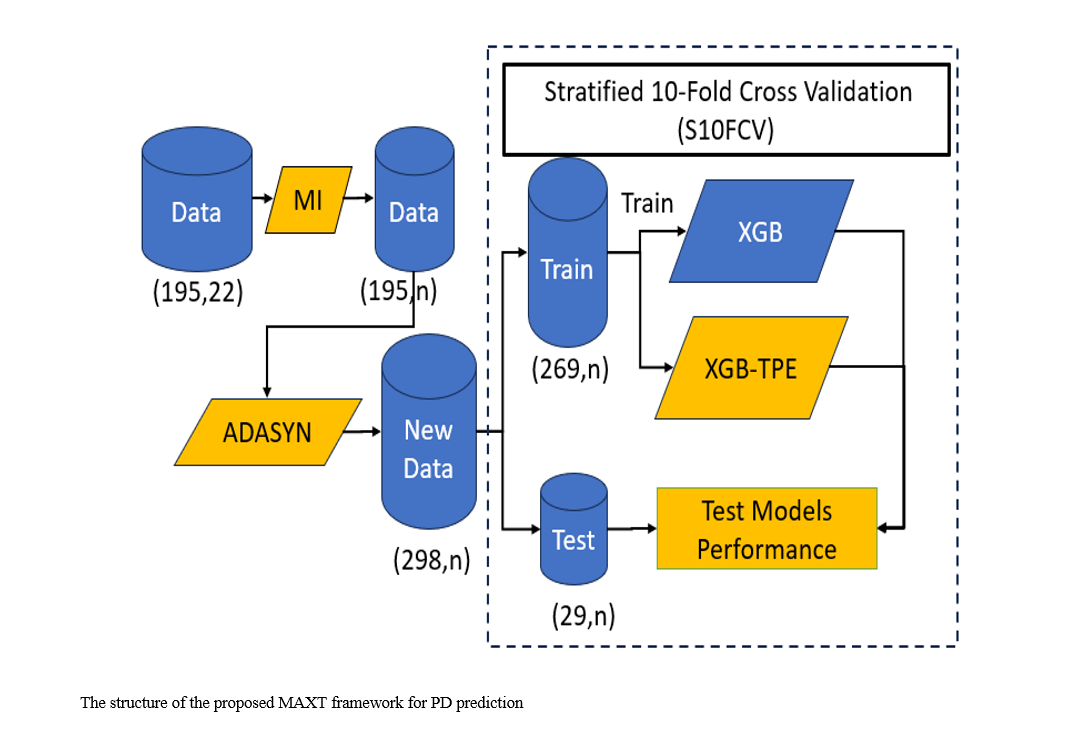
Early detection of Parkinson’s disease (PD) is essential for timely medical intervention and improving patient outcomes. Speech signal analysis offers a non-invasive, cost-effective, and easily deployable diagnostic pathway. However, achieving reliable early prediction remains challenging due to data imbalance, redundant features, and model instability. This study aims to develop an optimized and robust machine learning framework that enhances the predictive accuracy and stability of PD detection from speech data. An optimized machine learning model based on eXtreme Gradient Boosting (XGBoost) was developed for early PD prediction. The model’s hyperparameters were tuned using the Tree-structured Parzen Estimator (TPE), while Mutual Information (MI) was employed to select the most informative features from the speech dataset. To address class imbalance, the Adaptive Synthetic Sampling Approach for Imbalanced Learning (ADASYN) was applied to generate synthetic minority samples. Model performance and stability were evaluated using ten independent runs of Stratified 10-Fold Cross-Validation (SCV). The proposed framework achieved superior predictive performance with an average accuracy of 97.27%, precision of 98.79%, F1-score of 97.18%, recall of 95.77%, and ROC-AUC of 98.11% across multiple evaluations. Comparative analysis with similar studies demonstrated improved robustness, reliability, and balance between sensitivity and specificity. The integration of MI-based feature selection and ADASYN-based data augmentation significantly enhanced the performance and stability of the XGBoost model for early PD prediction. The proposed model demonstrates strong potential for clinical use as a decision support system, providing a low-cost, non-invasive, and remotely deployable tool for early PD diagnosis using patient speech signals.
About the Journal
- Editor-in-Chief: Prof. Hadi Sharif Moghaddam
- Owner: The Research Department of Economics and Management of Tomorrow's Innovators
- Chief Editor: Hadi Sharif Moghadam
- Publisher: The Research Department of Economics and Management of Tomorrow's Innovators
- Contact mail: mses.journal@gmail.com
- Open access: Yes
- Peer-review: Yes
- Article Processing Charges: Free
Management Strategies and Engineering Sciences (MSES) is a cutting-edge, interdisciplinary academic journal committed to advancing the fields of management, engineering, and related sciences. It seeks to publish high-quality, original research that bridges the gap between theory and practice, offering insights that contribute to both academic knowledge and industry applications. As an open-access journal, MSES ensures that all published articles are freely available to the global community without any subscription or access fees. This open-access model promotes greater dissemination and visibility of research findings, supporting a more inclusive and equitable scholarly environment.
MSES is dedicated to upholding the highest standards of scholarly publishing. The journal operates under a double-blind anonymous peer-review process, ensuring the integrity, objectivity, and quality of the research it publishes. This rigorous review system involves at least two or three expert reviewers for each submitted manuscript, who provide critical feedback to help authors refine and strengthen their work.
MSES publishes articles across a range of topics, including but not limited to management strategies, industrial and systems engineering, production management, engineering sciences, business operations, and technological innovation. The journal is indexed in several reputable databases and archiving services, ensuring that published works are preserved and widely accessible for years to come. With a commitment to fostering cross-disciplinary collaboration and innovation, MSES serves as a valuable resource for scholars, practitioners, and policymakers alike.